
King County Projected Versus Actual
The exact label matters. TDCJ uses Projected Release Date for a calculated future date on a current prison record. It is not a promise. After a favorable parole decision and release certificate, Classification and Records audits the case and may post a later Scheduled Release Date and scheduled location. The actual release is the later custody event recorded by the agency that let the person leave or transferred the person.
A King County pretrial detainee usually has no calculated prison date. Bond, a court order, dismissal, a plea, or a later sentence controls the next step. Since King has no listed local jail capacity, first ask the King County Sheriff where the person was housed. If Garza held the person, Garza can confirm its own exit or transfer. A Garza release to TDCJ is not community release.
Find King County Projected Dates
Follow the custody path. The TDCJ search applies only after state transfer and covers people presently incarcerated in TDCJ. It is not a complete archive of discharged Texans. County custody, state prison, federal custody, and immigration custody each use a different record.
- Obtain the King County judgment, sentence, case number, and jail-credit information from the proper clerk.
- Ask the King County Sheriff which jail actually housed the person.
- For state custody, open the TDCJ inmate search and use the TDCJ or SID number when known.
- For a name search, compare age, offense, conviction county, sentence, and identifiers.
- Read Projected Release Date, Maximum Sentence Date, and parole eligibility as separate milestones.
- If the result is absent or unclear, call TDCJ at 936-295-6371 or 800-535-0283 during its published weekday business hours.
- After the date passes, obtain the release or transfer event through the King County release-record path.
TDCJ says an email request to pia@tdcj.texas.gov may seek listed status data without charge. Supply the full name and TDCJ number, or exact birth date, approximate age, and conviction county if the number is unknown. Preserve the identifier for each later inquiry.
Open the official TDCJ current-inmate search to see its fields.
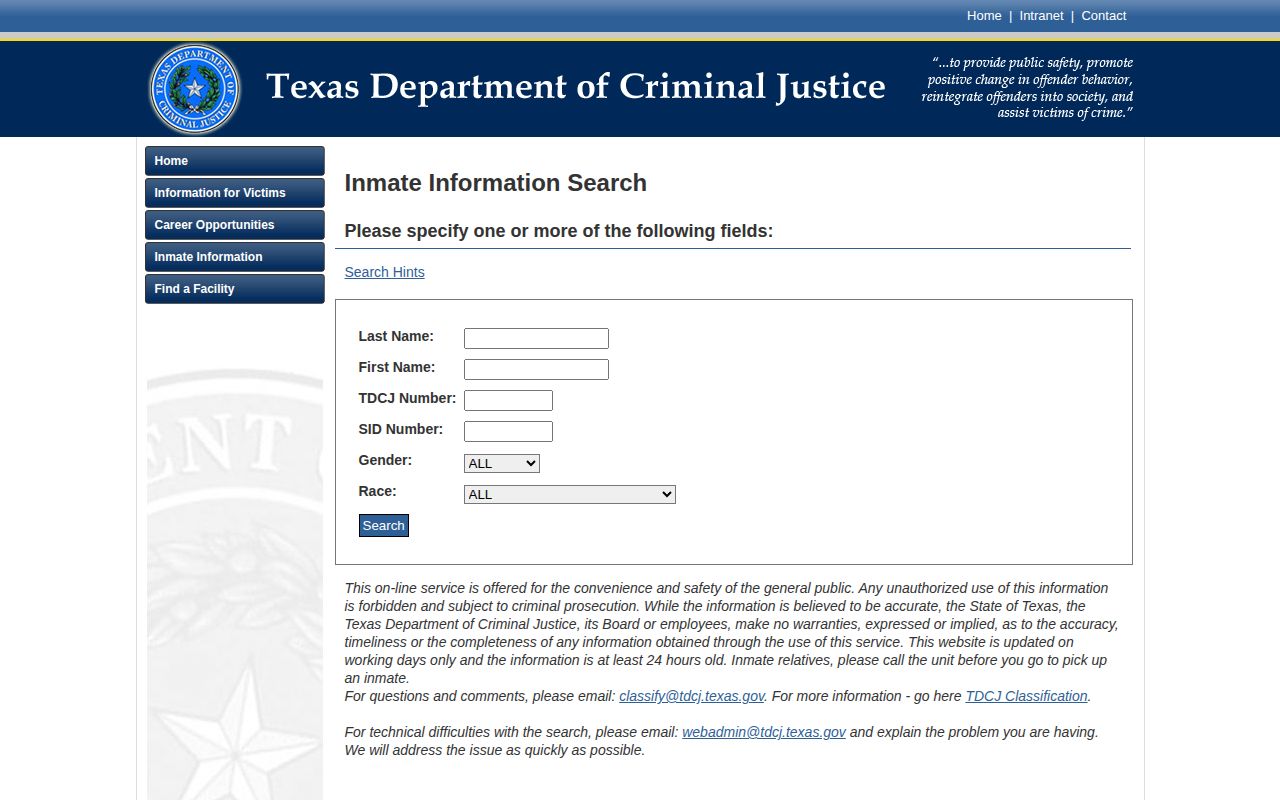
The search screen is the state-prison route. It does not calculate a bond date or a Garza County Jail release.
Texas Release Date Calculations
Texas has no universal rule that every prisoner serves 85 percent. That claim strips away the offense, offense date, sentence, credit, and eligibility rules that govern a real record. TDCJ begins with sentence and jail-credit data received from the court. It identifies the maximum sentence date, applies authorized calendar and good-conduct credit to the calculations for which the law allows them, and accounts for restrictions tied to the offense and date.
Government Code Chapter 498 governs classification and good-conduct time. Good time can affect classification and certain eligibility calculations, but it is generally not a vested reduction of the sentence itself. Government Code Chapter 508 supplies the branching parole and mandatory-supervision rules. Section 508.145 contains offense-specific parole eligibility provisions. Section 508.149 excludes listed categories from mandatory supervision.
A parole eligibility date means the Board may consider release. It is not a release order. Parole remains discretionary. Mandatory supervision is unavailable to some people. Use the judgment, offense date, and current statute instead of applying a single percentage.
Note: Good-conduct time may affect an authorized calculation, but it does not guarantee a particular King County release date.
Why King County Dates Change
A projection is recalculated when the legal or custody inputs change. Some updates move a date forward. Others move it back. A detainer is a request or legal basis for another authority to take custody, so departure from TDCJ may result in transfer rather than freedom.
| Change | Possible effect | Record to verify |
|---|---|---|
| Corrected jail credit | Revises time credited before admission | Judgment and TDCJ calculation |
| Concurrent or consecutive terms | Changes how sentences overlap | Signed court order |
| Disciplinary credit action | Changes eligible credit treatment | TDCJ classification record |
| New sentence or detainer | May delay release or cause transfer | Court and agency record |
| Board vote or rescission | May advance, condition, or cancel processing | Board and TDCJ status |
| Data correction | Repairs a source or calculation error | Updated official detail |
A favorable Board vote may still be followed by residence approval, a required program, special conditions, a release certificate, or a case audit. The Board makes parole decisions. TDCJ Parole Division handles release processing and supervision. Neither role belongs to the King County jail custodian.
King County Scheduled Release Channel
TDCJ distinguishes the projected field from the later scheduled field. Its Independent Ombudsman FAQ says Classification and Records audits a case after receiving the release certificate, typically in about 14 to 21 business days. A scheduled date and location may then appear. That processing range is not a promise for one person, and the date can still change.
Before a Board vote, call the BPP status number at 844-512-0461. After a favorable vote, the Parole Division release-status line is 512-406-5202. Give the TDCJ or SID number, or the exact date of birth where accepted. For notification, TDCJ's IVSS covers prison, parole, and mandatory-supervision events. County Texas VINE is separate.
Review the official TDCJ telephone channels before calling.
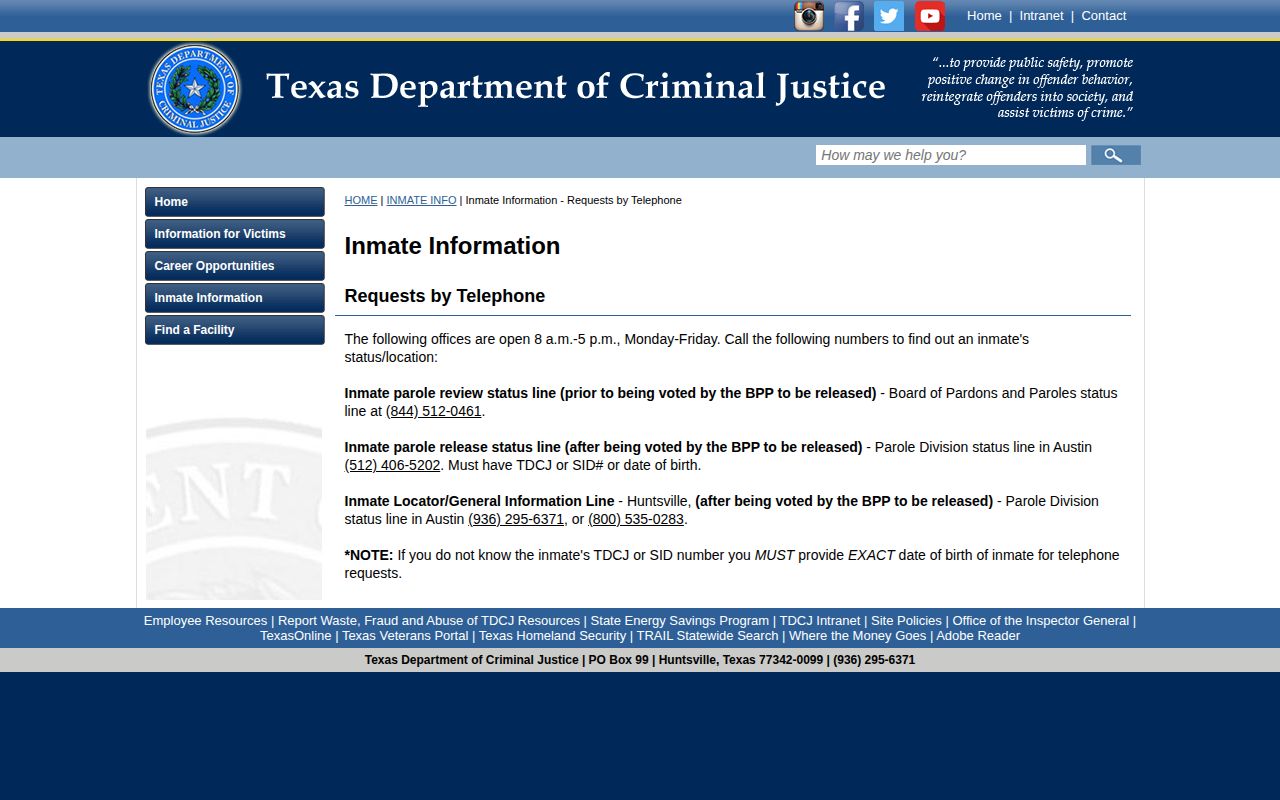
The source separates pre-vote and post-vote contacts, preventing a Board decision from being mistaken for actual release.
King County Jail Date Requests
No public King or Garza local good-time formula, weekend adjustment, or holiday-release policy was found. Do not borrow TDCJ rules for a county sentence. Ask the sentencing clerk for the commitment and credited days. Then ask the actual housing jail for its calculation and later discharge entry. King Sheriff can identify the custodian; Garza applies only when it actually housed the person.
A pretrial case needs a different question. Look for bond, dismissal, plea, judgment, or commitment. The court order may authorize release, but the jail event supplies the actual exit or transfer time. If the record says released to TDCJ, ICE, or another county, follow the receiving system before saying the person entered the community.
Confirm King County Actual Release
Only the later status or event record confirms what occurred. Ask the releasing custodian for the date, time, release type, legal authority, and destination. Pair it with the judgment or Board outcome. A person who no longer appears in the current TDCJ locator might be released, supervised, transferred, outside the scope, or mismatched. Absence is not a discharge record.
For a Garza-held King detainee, request Garza's custody transaction and King's case record. For a state prisoner, use TDCJ status and Parole Division. For a federal prisoner, use the BOP locator; “RELEASED” means no longer in BOP custody, not necessarily free of another jurisdiction or supervision. The custody chain supplies the full answer.
A court file often explains the legal authority better than a locator. King County's County Clerk and 50th District Clerk routes can contain a bond order, dismissal, judgment, sentence, commitment, jail-credit notation, revocation, or discharge-related order. The order may not state the physical exit time, so pair it with the custodian's event. Conversely, a jail event may use a short transfer code without explaining the court action. Both records resolve the date more accurately.
When requesting a county calculation, ask for existing records rather than an answer to a math question. Name the commitment, credited-days entry, custody-event history, sentence calculation, release transaction, and destination field. A governmental body need not create a custom calculation or new list. If an active case or confidential material limits access, request the nonconfidential date, type, and destination separately.
Notification is useful but secondary. Texas VINE can flag a jail release or transfer at a participating facility. IVSS covers relevant TDCJ events. Neither service promises a complete historical archive, and a transfer alert is not community release. Call the agency named in the alert and request the actual event record.
King County Release Date Labels
Maximum Sentence Date marks the sentence's maximum endpoint based on the official calculation, while parole eligibility marks when discretionary consideration may begin. Projected Release Date is TDCJ's current calculation. Scheduled Release Date appears only after later processing reaches that stage. None of these labels records a King or Garza bond release. Each belongs to a specific state-prison record and must be read with the current status.
Transfers create another source of confusion. A county jail may close its custody event when delivering someone to TDCJ, USMS, ICE, or another county. That is release from the jail's legal custody, but the person stays confined. Record the destination and check the receiving agency. A detainer may also route a planned TDCJ release to another custodian rather than an approved residence.
Use a dated answer. Court corrections, restored or forfeited credit, a new sentence, Board action, and data repair can change an older projection. Save the TDCJ or SID number and ask which date field the agency is quoting. A precise label prevents a tentative calculation from being repeated as an actual gate date. Then request the later release transaction to learn what truly happened.
A final date check should also record the source and time of inquiry. Dynamic TDCJ fields can update after a court correction, classification action, or release-processing step. A saved projected date is evidence of what the system displayed then, not permanent proof of what happened later. Confirm the current label, ask whether another agency will receive the person, and obtain the completed transaction after the event. This method keeps a King County prison projection separate from a county-jail release, a court-authorized bond, and a transfer that continues custody elsewhere.
Public Record Search
Sponsored Results