
King County 72-Hour Feed Status
The King County Sheriff publishes contact information but no current roster, release archive, or 72-hour view. The official Garza County Sheriff and jail page also has no 72-hour, 48-hour, or other rolling release list. Its VINELink and Facebook links do not create a multi-day archive. As of the August 2, 2026 research date, no official field list, update cadence, image flag, or retention period could be supported.
King County has zero jail capacity in the state countywide report, so people arrested there can be housed elsewhere. A 2025 King County agenda proposed an inmate-housing agreement with Garza, but the agenda alone does not establish a current contract. Even a future Garza feed would include Garza bookings, not every King arrest. The Sheriff must identify the actual custodian first.
Build a King County Three-Day Record
A multi-day reconstruction is different from a quick “is this person out now?” call. Define the date range, locate each relevant custodian, request existing event entries, and match them to court authority. Use exact start and end dates and state whether the range refers to calendar days. This gives the records officer a clear target without asking the agency to conduct research or create a new analysis.
- Ask the King County Sheriff at 806-596-4413 which jail or jails housed the person during the chosen three-day span.
- Contact each confirmed jail and ask whether it maintains an existing custody-event or release log for that range.
- Request the relevant booking number, departure date and time, event type, authority, and receiving agency.
- Use Texas VINE only to check a matching person or prior notification; do not treat it as a rolling archive.
- Match each event with the King County court’s bond order, dismissal, judgment, sentence, or commitment.
- Follow a transfer into TDCJ, another county, federal custody, or immigration custody in that system.
A useful request asks for existing “custody/release log entries for King County prisoners with a release or transfer event between [start] and [end], including name, booking number, event date/time, release type or authority, and receiving agency, with confidential information redacted as required.” The office need not create a special report that does not exist.
King County 72-Hour Record Fields
No official online table displays these fields. They are the items most useful in a written three-day request, based on the King and Garza record inventory. Some may be withheld or redacted under Texas law, and a custodian’s labels may differ. Requesting the destination is vital because a release from one jail can be a transfer into another agency’s custody.
| Requested field | Purpose in the three-day reconstruction |
|---|---|
| Name and booking number | Separates people with similar names and links records. |
| Booking and admission time | Sets the start of that facility’s custody period. |
| Housing facility | Identifies the office responsible for the event. |
| Departure date and time | Places the event within the requested window. |
| Release type or authority | Distinguishes bond, court action, completion, and transfer. |
| Destination agency | Shows whether custody continued elsewhere. |
King may retain arrest and contract-custody material while Garza or another outside jail holds the physical booking and departure entries. The court holds the legal record that explains bond, dismissal, judgment, commitment, or revocation. A sound reconstruction can require all three sources.
King County Weekend Release Gaps
A 72-hour span can cross a weekend, holiday, or an office closure, but the research found no local rule that King or Garza releases people on a stated schedule. Do not import the published TDCJ weekday release hours into the county-jail context. TDCJ rules apply to state-prison releases, not to a bond or court release from the Garza jail.
Use a wider date range when an expected event falls near a boundary. A late entry, transfer, or record correction may fall outside an initial one-day inquiry. Ask the custodian for the actual event timestamp and authority. Then check whether the receiving office recorded admission on the same or next date. Different systems can post at different times.
If the goal is urgent confirmation today rather than reconstructing several days, the King County 24-Hour Release List page gives the direct same-day call sequence. The 72-hour method is better for establishing a short chronology.
Note: No documented King or Garza cadence supports calling either feed real-time, daily, or retained for a fixed number of days.
Why King County Records Are Split
Neither King nor Garza maintains a public rolling release list, and King’s zero-capacity structure makes the missing feed more consequential. An arrest can begin with King County, pass through an outside jail, and end in community release or transfer. Each office records its own part. Texas VINE may send an event notice for a participating facility, but it does not replace a three-day archive.
The strongest short chronology follows the chain: King arresting agency, actual housing jail, jail departure entry, receiving custodian if any, and court authority. A no-match from one point cannot close the inquiry. The person may be under a variant name, outside the portal’s scope, at another jail, or moved to a state or federal system.
The manifest capture of the King County Sheriff page identifies the office that can resolve the first link:
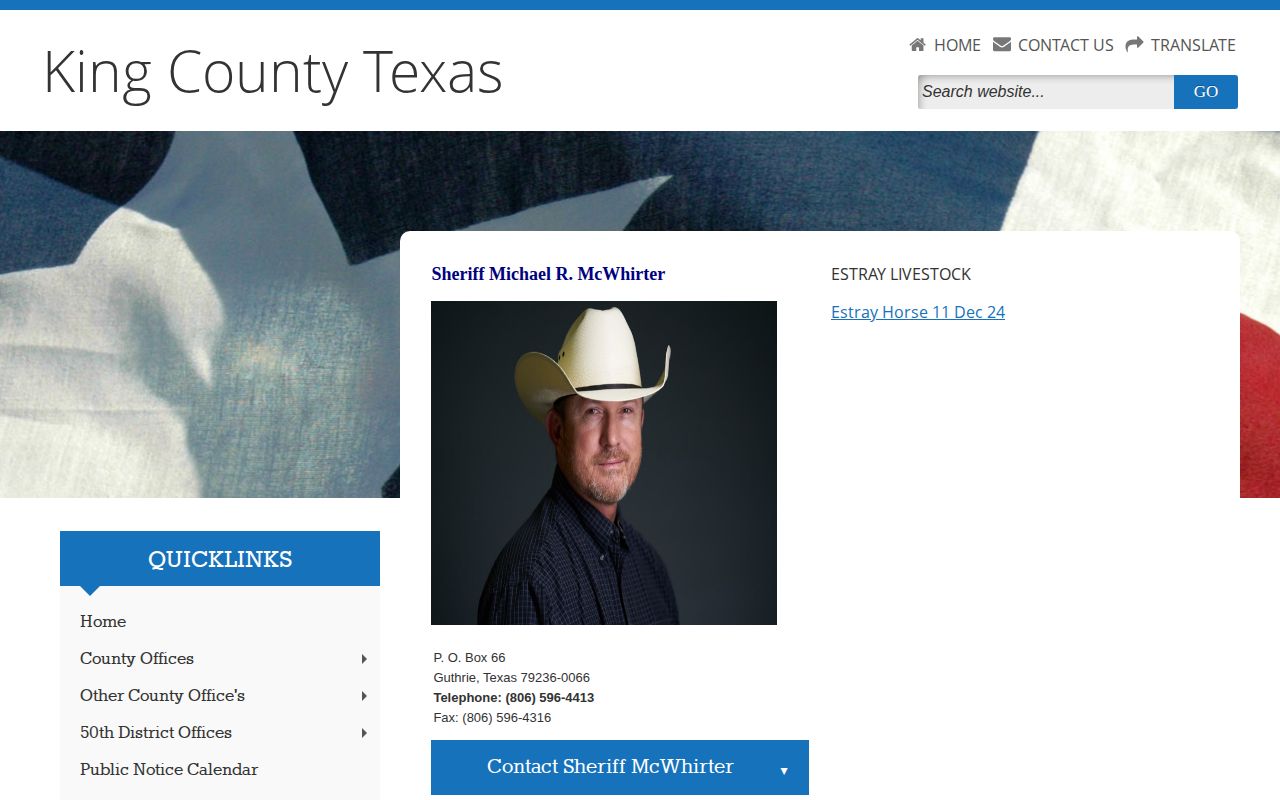
After the Sheriff names the jail, direct the date-range request to the custodian that created the departure entries.
Classify King County Release Events
A release list can blur distinct outcomes. Bond, a personal-recognizance or court order, dismissal, time served, sentence completion, or probation disposition may mean the person returned to the community. A transfer to TDCJ, another county, ICE, USMS, a hospital, or another secure setting does not mean freedom from custody.
| Three-day finding | How to verify next |
|---|---|
| Community release | Confirm the jail event and its signed court authority. |
| Transfer to another jail | Contact the receiving jail for admission and current status. |
| Transfer to TDCJ | Use the current TDCJ offender search and status channels. |
| Federal transfer | Trace host-jail or USMS custody, then BOP if designated. |
| Immigration transfer | Check ICE ODLS while noting its scope and delays. |
A TDCJ current result concerns state-prison custody. It does not prove the details of the earlier King or Garza jail departure. Likewise, a BOP “RELEASED” result means the person is no longer in BOP custody and does not rule out another jurisdiction.
Preserve King County Release Proof
When Garza is confirmed as the housing jail, its purpose-neutral open-records form can target the booking sheet, custody history, release transaction, and transfer entry. The form states Garza-specific terms for processing, copying, estimates, and pickup. King County may have a separate arrest or placement record. Ask each office only for records it maintains.
Keep the response, booking identifier, event language, and court document together. A docket label alone may omit the signed order’s detail. If a portal result is unclear, contact the County Clerk or 50th District Clerk and ask which court handled the case. Court records often remain after a short-lived jail entry disappears.
For one named person across every possible system, use the King County released inmate lookup. For a multi-day release list, stay focused on existing logs within the defined window and do not infer an event from absence.
When the three-day span includes a state transfer, keep the county and state events separate. The housing jail's entry proves its departure, while the TDCJ profile can prove current state custody and may show a projected date. After a favorable parole vote or later state release, TDCJ status, Parole Division, and IVSS provide the state-specific trail. None changes the wording or time of the earlier county event.
Note: Recheck the current housing arrangement and live agency pages because facilities, portal labels, and participation can change after the research date.