
Understanding King County Releases
A King County release inquiry starts with an unusual local fact: no official King County jail roster or local jail facility was found. The Texas Commission on Jail Standards countywide report lists King County with zero jail capacity and zero average daily population. Arrests and custody records can still exist. A person may be booked into an outside jail, appear in a King court case, transfer to TDCJ, and later leave custody. The absence of a local roster is therefore a clue about the county's structure, not proof that nobody was arrested or released.
“Released” must be tied to a custodian. A person can leave a housing jail on bond, under a court order, after completing confinement, or on another lawful community disposition. The same jail may record a release when it transfers the person to TDCJ, another county, the U.S. Marshals Service, or ICE. That is a release from one agency, but not from custody. Reliable verification identifies the housing facility, obtains its dated event and destination, and then checks the legal authority or receiving agency.
King County Release Types
The release type determines which record should appear next. A bond or personal-recognizance order permits release while a case continues. Dismissal ends the charge addressed by that order, though another hold can still control custody. Time served or sentence completion ends the confinement calculated for that case. Probation, called community supervision in Texas, can follow a court disposition without a state-prison release. Parole and mandatory supervision follow TDCJ custody and remain subject to state supervision. Transfers require a search of the receiving system.
| Event | Meaning | Next source |
|---|---|---|
| Bond or court order | Release may occur while the case remains open. | Housing-jail event and signed court order |
| Dismissal | The identified charge is dismissed, subject to other holds. | Clerk's dismissal and jail record |
| Time served or completion | The custodian calculates the authorized custody end. | Commitment, credit calculation, discharge entry |
| Probation | Court-ordered community supervision may replace or follow custody. | King court and 50th District CSCD |
| TDCJ transfer | County-jail custody ends while state custody begins. | TDCJ current inmate search |
| Federal or ICE transfer | Another jurisdiction takes custody. | USMS/BOP or ICE records |
What King Release Records Show
A release record is usually a set of linked entries, not one standard certificate. Request the arrest and booking tie-back, custody-event history, release transaction, transfer record, and any order or judgment that authorized the event. Field names vary by custodian, so identify the facts needed rather than insisting on a particular form title.
| Requested field | What it establishes |
|---|---|
| Full name and identifiers | Separates the subject from people with similar names. |
| Arresting agency and booking number | Connects the King arrest to the housing record. |
| Admission date, time, and facility | Shows when and where physical custody began. |
| Charge, court, and bond | Connects custody to the criminal case and release authority. |
| Custody-status history | Shows internal moves and changes before departure. |
| Release date, time, and type | Identifies when that custodian's control ended and why. |
| Destination agency | Distinguishes community release from transfer. |
A booking sheet may also include a photograph, physical descriptors, warrant or charge data, and the arresting officer or agency. Public access can be limited by the Texas Public Information Act, other confidentiality laws, redaction duties, and case-specific exceptions. Ask for the minimum record needed to prove the event. There is no documented King or Garza online retention period, so do not assume a name remains visible for one or three days.
Request King County Release Records
Send a written request to the governmental body that maintains the existing record. King may hold the arrest and case trail, while an outside jail holds its own booking and release transaction. The Garza open-records form is the durable route after Garza housing is confirmed. Its stated terms include one dollar per page, added charges above 50 pages, an estimate when charges exceed 40 dollars, and pickup within 15 calendar days after notice. Those terms belong to Garza's form and must not be applied to King or TDCJ requests.
- Identify the person with full name, date of birth, incident date, and booking number if known.
- Name the existing documents: booking sheet, custody-event log, release transaction, transfer entry, and destination field.
- Give a narrow date range and request electronic copies when available.
- Ask the custodian to redact protected data and release the remainder.
- Pair the response with the signed bond order, dismissal, judgment, sentence, or commitment from the proper clerk.
The Texas Attorney General explains that an office need not answer questions, perform research, create a record, or provide future records continuously. A request for “why someone was released” is less effective than a request for the dated transaction and authority fields. Keep the response, because a web result may later change or disappear.
Texas Law on King Releases
The Texas Public Information Act governs many requests to county and state agencies. Section 552.108(c) preserves access to basic information about an arrested person, arrest, or crime even when other law-enforcement information is excepted. Section 552.134 separately protects much TDCJ inmate information while identifying public categories. Judicial records follow court-access rules, so the county or district clerk should explain copies, certification, and restricted filings.
Expunction under Code of Criminal Procedure Chapter 55A and nondisclosure under the framework in Government Code Chapter 411 are different remedies with distinct eligibility and effects. Neither should be described as automatic. Juvenile, sealed, expunged, confidential, and case-excepted material may be withheld or redacted. A clerk or lawyer can address how a specific order affects access; the release custodian remains the source for any record still public.
Find Released King County Inmates
Facility resolution comes before a name search. The King County Sheriff is the starting point because King publishes no roster and may use outside housing. Ask where the person was booked and whether the outcome was community release, court release, completion, or delivery to another authority. If Garza housed the person, use its jail contact and records form. If another jail is named, follow that custodian instead.
- Call King County with identity and incident details, then obtain the actual housing jail and booking identifier.
- Ask that jail for current custody or the dated release or transfer event, including destination.
- Use Texas VINE against the confirmed facility for a matching record or future alert. No result does not prove release.
- Read the County Clerk or 50th District Clerk case for the bond, dismissal, judgment, sentence, revocation, or commitment.
- Switch to TDCJ, BOP, or ICE when the event names one of those custody systems.
- Request written records when phone or online information is incomplete.
The 24-Hour Release List page explains the same-day fallback when no official feed exists. For a person in state prison, the Projected Release Date page explains what TDCJ's calculated field can and cannot prove.
King County TDCJ Offender Search
The Texas Department of Criminal Justice inmate search covers people currently incarcerated in TDCJ. It is not a complete archive of discharged Texans. Use it when a county-jail event says the person transferred to state custody. Search by TDCJ number or State Identification number when known. Otherwise use the exact last name, at least a first initial, and offered identity filters, then compare age, offense, conviction county, and sentence.
| Search input | Best use | Caution |
|---|---|---|
| TDCJ number | Direct state-record match | Preserve it for later requests |
| SID number | Texas identity match | Confirm all identifiers |
| Last and first name | Search when numbers are unknown | Common names require more checks |
| Sex and race filters | Narrow possible matches | Do not rely on one field alone |
A current detail can show the facility, offense and sentence information, maximum sentence date, parole eligibility information, and a Projected Release Date. That date may change due to credits, discipline, court corrections, new sentences, detainers, Board decisions, or release processing. If the person no longer appears, contact TDCJ status, Parole Division, and records channels. Disappearance from a current-only locator is not an official discharge entry.
The official TDCJ search screen shows the fields available before a query.
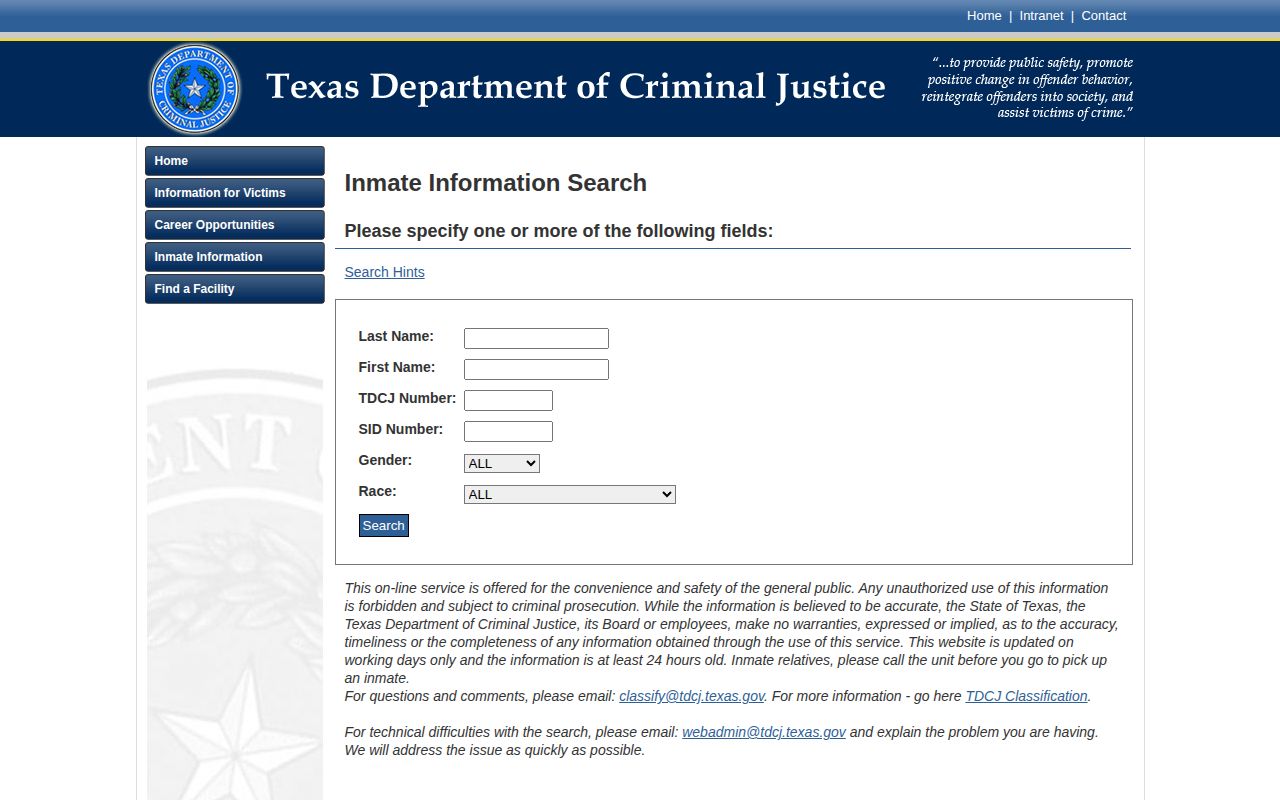
The interface should be used for state prisoners, while a King or Garza jail release remains a county-record question.
King County Recent Release Search
No official King County current roster, 24-hour view, 72-hour view, recent-release archive, or booking-photo gallery was found. The documented Garza jail page provides contacts, a records form, a VINELink link, and a sheriff Facebook link, but no rolling release feed. No official jail-information app was linked by either county. It would be inaccurate to claim an update cadence, retention window, or photo field.
The usable substitute is King Sheriff, actual housing jail, direct event confirmation, VINE for a participating live record, a written date-bounded request, and the court file. Garza Facebook may carry occasional agency communication, but it is not a full roster and cannot establish a later disposition. Even if Garza adds a feed, it would cover Garza bookings rather than every King arrest.
The official King Sheriff contact page is the source for resolving the housing facility.

This contact-first route reflects the county's zero-capacity jail structure and avoids false conclusions from an empty web search.
King County Post-Release Supervision
Parole, mandatory supervision, and probation are different. The Texas Board of Pardons and Paroles decides parole release. TDCJ Parole Division handles parole and mandatory-supervision cases after prison release under Government Code Chapter 508. Probation, termed community supervision in Texas, is ordered by a court under Code of Criminal Procedure Chapter 42A and may occur without a prison term.
King County identifies the regional 50th District Community Supervision Correction Department in Seymour for local probation. A matching probation case does not prove a TDCJ release. For a state-prison release, use TDCJ status and Parole Division channels with the TDCJ or SID number. A favorable Board vote also is not the physical release event, because conditions, release-plan approval, detainers, or processing may intervene. The Parole & Probation page separates these paths and their official contacts.
King Release Alerts and Transfers
Texas VINE offers custody and court-event search and notification for participating sources. For a King arrest, first learn the housing jail, then search that facility. Garza's official jail page directly links VINELink, but King participation was not independently confirmed. Register while a matching person is shown in custody. Alerts may include release, transfer, escape, or death. Always call the facility after an alert to obtain the event type, authority, and destination.
State-prison and parole notifications use TDCJ IVSS, which replaced TDCJ's former VINE service. A federal case may pass through a local host jail and USMS custody before BOP designation. The BOP locator can show a federal release date; “RELEASED” means no longer in BOP custody, not necessarily free from every hold or supervision term. ICE ODLS covers current and certain recent ICE cases, subject to its limitations. None of these systems replaces the King or housing-jail event.
Where King Release Records Remain
Current custody and past release require different evidence. Use each system for the event it owns, then connect the records by identifier and date.
| System | Best question | Released-person limit |
|---|---|---|
| King Sheriff | Where was the person housed? | No online roster or release archive found |
| Housing jail | When and how did its custody end? | Must obtain the destination on transfer |
| King court | What legal order explains the event? | Docket alone may not show physical release time |
| TDCJ | Is the person currently in state prison? | Public locator is not a full discharge archive |
| Parole/CSCD | Does post-release supervision apply? | Supervision is not the original jail event |
| BOP or ICE | Did another jurisdiction hold or release the person? | Only covers that federal or immigration custody |
King County Facility Resolution
The county's zero-capacity structure makes agency-to-facility resolution the first search step. A person can disappear from one office's web view while remaining in another agency's custody. Call King Sheriff, ask for the actual booking and housing facility, and follow that facility's dated event to the named destination. Do not search a fictional “King County Jail” or confuse this Texas county with King County, Washington.
The only adult facility in the research map is the Garza County Law Enforcement Center / Garza County Jail. It is outside King County and is included because a September 2025 King agenda proposed an inmate-housing agreement. The proposal must remain qualified until an executed agreement or current placement is confirmed.
Why King Has No Jail Roster
The TCJS report lists jail capacity and average daily population at zero for King County. Those are structural custody measures, not arrest or annual release statistics. The reported countywide population does not change the workflow. A King arrest can generate sheriff, court, housing-jail, transfer, and state-custody records even though no person appears on a local jail webpage.
This distinction prevents a common error. An empty search result does not establish that the person went home. It can mean outside housing, a transfer, a spelling mismatch, a system delay, or a record that is not published online. The dated release or transfer transaction is the starting proof; the destination determines what must be checked next.
Get a Durable King Release Record
A phone call can orient an urgent inquiry, but the Garza purpose-neutral open-records form creates a record of the request and response. Its incident and person fields can target the booking sheet, release transaction, transfer entry, and photograph. Use it only after confirming Garza held the person. Do not confuse it with an unrelated applicant authorization form.
King and Garza may each own part of the trail. Ask King for arrest and county-maintained custody material, Garza for its physical booking and departure, and the clerk for the signed legal order. This three-record package is stronger than a transient online status and makes it clear whether “release” meant the community or another custodian.
King Court Records Explain Disappearance
The County Clerk and 50th District Clerk pages publish the same Guthrie office contact and link to Online Records Search and iDocket paths. That trail matters more in King County because there is no local jail archive. Misdemeanor and felony jurisdiction differ, so start with the clerk for the charge or ask the office to route the case number.
Look for the actual bond order, dismissal, judgment, sentence, commitment, revocation, or discharge-related filing. A docket label is a lead; a signed document supplies the authority. The County Clerk page illustrates the local court route.
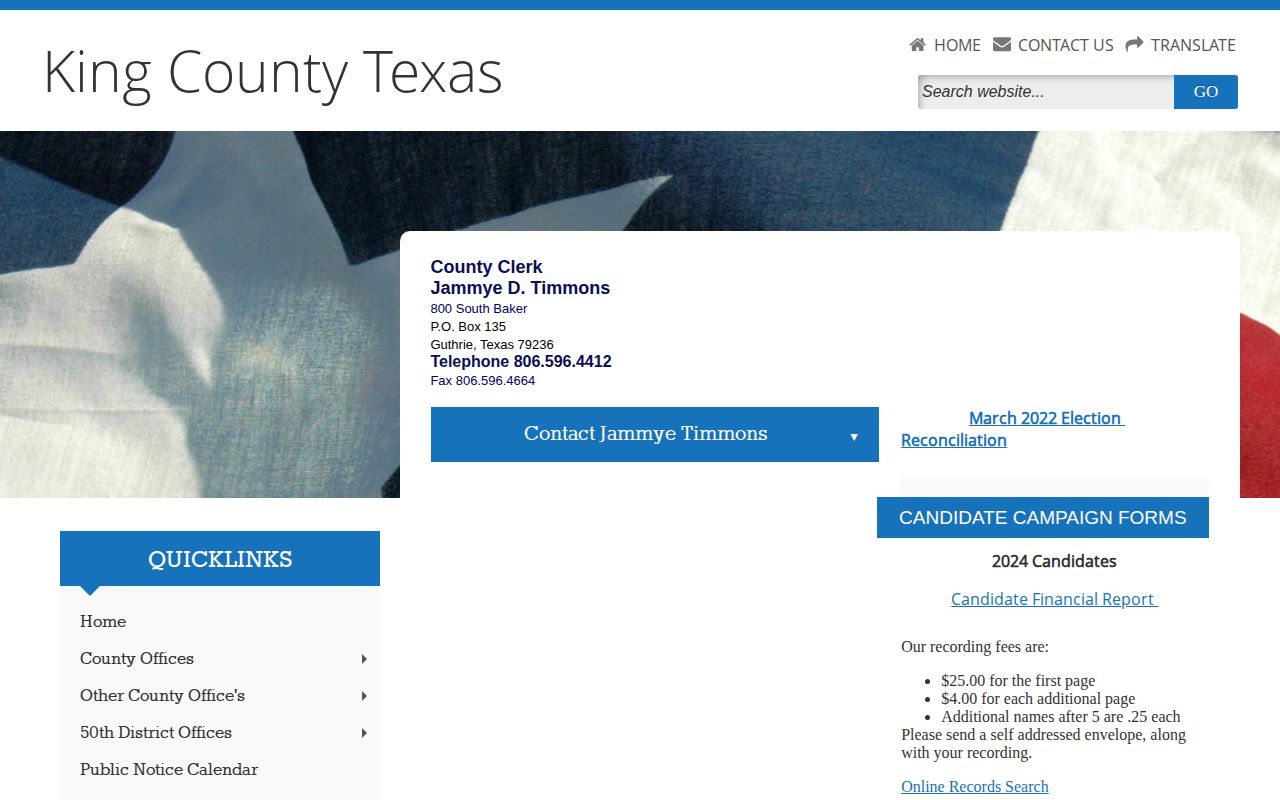
Pair the court document with the custodian's event because legal authority and physical release processing are separate facts.
Was a King Inmate in Garza?
King County's September 8, 2025 agenda specifically proposed housing prisoners at the Garza County Law Enforcement Center/Jail. The agenda proves that officials placed the arrangement before the court, but it does not prove approval, present operation, or any individual's placement. Preserving “proposed” is essential.
Ask King where the person was sent, then ask the named jail for its own record. If Garza confirms the booking, its event can document bond, a court release, completion, or transfer. If King identifies a different housing jail, use that jail's contact, release record, photo policy, and VINE coverage instead of silently substituting Garza.
Note: Research was completed August 2, 2026; live officeholders, links, facility arrangements, and portal labels should be confirmed with the responsible agency.