
King County Parole Versus Probation
Parole and probation are not two names for the same status. Texas calls probation community supervision. A court can impose it instead of confinement or as part of a case disposition. Parole follows release from a Texas Department of Criminal Justice prison and leaves the person under the sentence. Mandatory supervision is another form of supervised release from TDCJ, based on the governing statute and eligibility rules. Neither status is proved by a departure from a county jail.
For a King County case, the source follows the legal path. The Texas Board of Pardons and Paroles decides whether to grant parole. The TDCJ Parole Division manages parole and mandatory-supervision cases after release. A sentencing court and the regional 50th District Community Supervision Correction Department handle probation. That division of work prevents a common error: calling the local probation office for a state parole vote, or asking TDCJ to explain a local probation order.
| Status | Who orders or decides it | Who supervises it | Best verification record |
|---|---|---|---|
| Parole | Texas Board of Pardons and Paroles | TDCJ Parole Division | Board status plus later TDCJ release and supervision status |
| Mandatory supervision | Statutory process with Board review where required | TDCJ Parole Division | TDCJ release and active-supervision record |
| Probation | Sentencing court | 50th District CSCD for the regional King County route | Court order and CSCD confirmation |
| Discharge | Depends on the sentence and supervising system | No active supervision once final | Official discharge or sentence-completion record |
- Parole
- Conditional release from state prison before the sentence obligation ends.
- Probation
- Court-ordered community supervision, often without a state-prison release.
- Absconder
- A person alleged to have stopped reporting or left supervision without authorization.
- Discharge
- The recorded end of the sentence or supervision obligation.
Verify King County Release Supervision
Start with the sentence, not a general name search. A King arrest may lead to release from an outside jail, transfer to TDCJ, probation, or another authority. King County has no listed local jail capacity, and Garza County is only a documented proposed or possible housing destination. The county-jail event therefore cannot identify the later supervisor by itself. Use a case number, TDCJ or SID number, full name, and date of birth when the agency accepts them.
- Read the King County court case for a probation order, judgment, commitment to TDCJ, revocation, or discharge entry.
- If the judgment imposed community supervision, contact the 50th District CSCD and ask which office holds the case and what public status can be confirmed.
- If the person entered TDCJ, check the current TDCJ record and use the Board status line at 844-512-0461 before a parole vote.
- After a favorable vote, call TDCJ Parole Division release status at 512-406-5202. A vote is not the physical release event.
- For active state supervision or location questions, contact TDCJ through io@tdcj.texas.gov and identify the person precisely.
- Pair the answer with the release or discharge record. The King County released-inmate search and records path explains how to obtain the underlying jail event.
A current-only TDCJ web search is useful while the person remains in prison. Once the record disappears, it does not prove discharge. The person could be on parole, mandatory supervision, transferred, outside the search scope, or mismatched by name. TDCJ status, Parole Division records, and the court judgment provide the needed follow-up.
Note: A favorable parole vote and a confirmed release are separate events, so verify both before describing a person as released.
King County Regional Probation Office
King County's probation route is regional. The county identifies the 50th District Community Supervision Correction Department in Seymour, rather than an office in Guthrie. This is the office for court-ordered community supervision in the district. It does not make parole decisions and does not supervise a TDCJ parole case merely because the original charge came from King County.
50th District Community Supervision Correction Department101 N. Washington
Seymour, TX 76380
Office: 940-888-3778
Fax: 940-888-2303
The official King County probation page is the source for this routing. Give the case number when possible. Ask whether the office supervises the named case and what status is public. Supervision notes, treatment details, residence data, and other case material may be restricted even when the court order is public.
The official page also provides useful visual confirmation of the regional route.
View the King County probation office source before contacting the district.
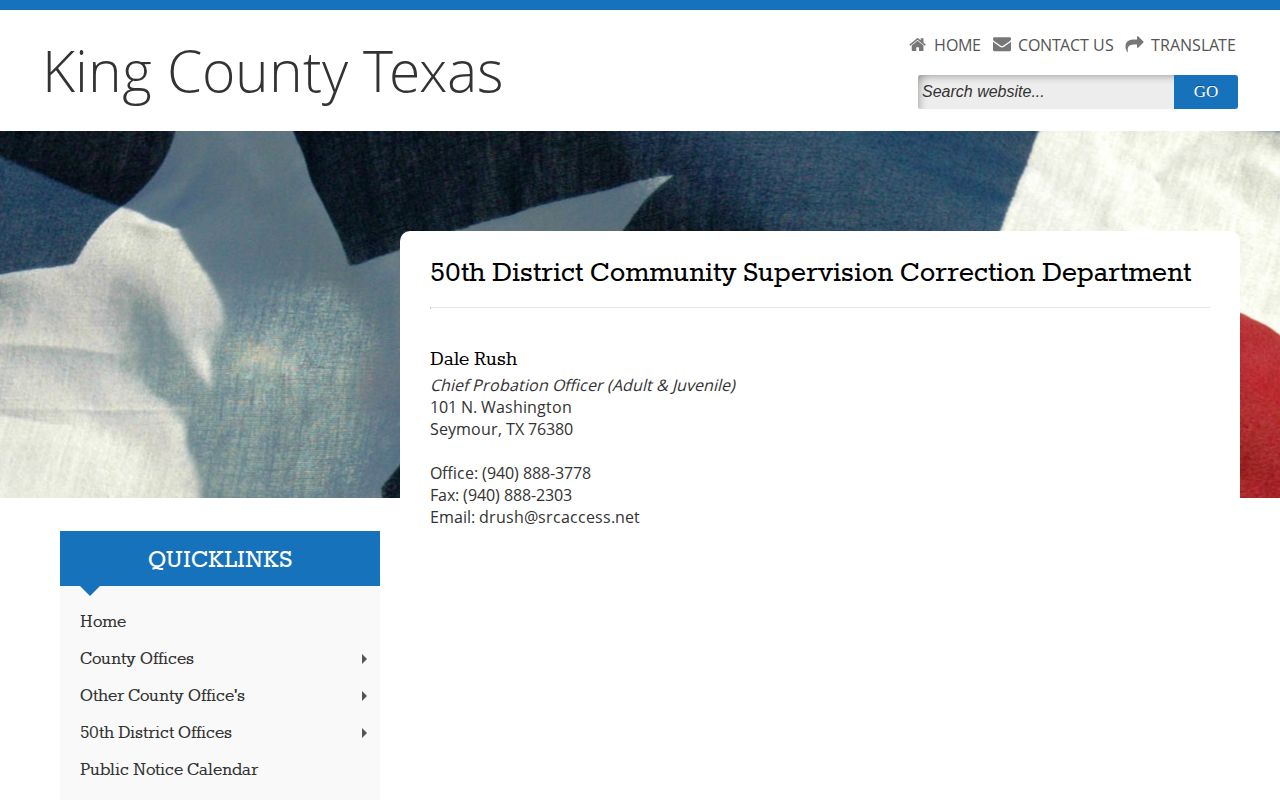
The captured page supports the Seymour contact, but an office reply remains the source for a particular person's current probation status.
King County Parole Decisions
Texas parole review is not an ordinary public courtroom hearing. The Board's Parole Panel Review FAQ explains that panel members review and vote on an individual file. There is no honest statewide public calendar of ordinary inmate hearings to search. Before the vote, use the Board status channel. After a favorable vote, switch to Parole Division release processing.
Vote codes carry more detail than a simple yes or no. An approval may require a later date, completion of a program, an approved residence, or another condition. A denial may set a later review or require service of the remaining term. Government Code Chapter 508 contains parole and mandatory-supervision rules, including offense-specific eligibility and exclusions. The offense date, judgment, sentence, and current statute all matter.
See the official Board review explanation for the Texas process.
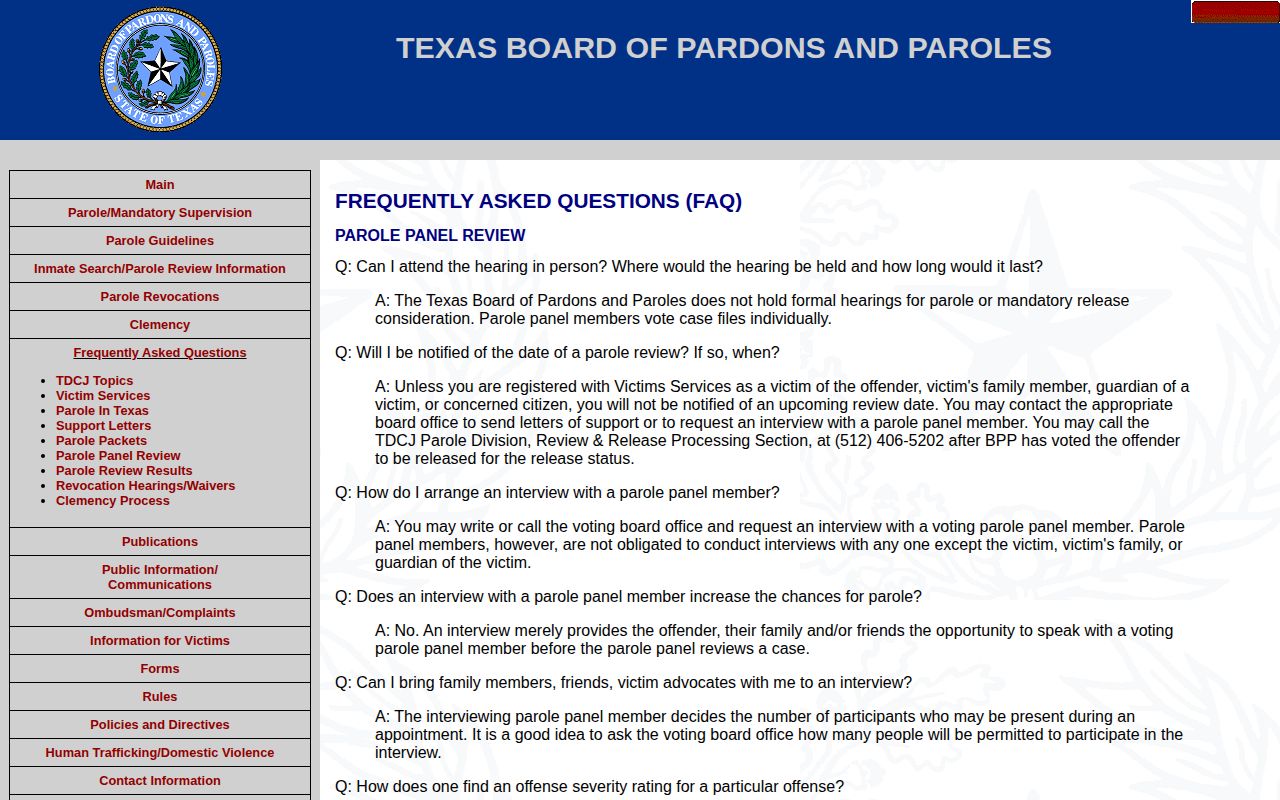
The source confirms file review, while the later TDCJ status event confirms whether physical release occurred.
King County Warrants and Revocation
A missed report or alleged violation does not authorize a public label of absconder. Verify an active warrant through TDCJ or law enforcement. No King County public absconder list was found. Parole revocation can involve preliminary and revocation hearings, and the outcome can include continued supervision, changed conditions, an intermediate sanction, or revocation and return to custody.
Probation violations go back through the court and regional CSCD path. Look for a motion to revoke, capias, warrant, amended condition, or signed revocation order in the King County case. A docket entry can flag the issue, but a signed order and agency status are stronger evidence. Texas VINE may report a custody event at a participating jail, while TDCJ's Integrated Victim Services System covers state-prison, parole, and mandatory-supervision events. They are separate systems.
Note: A transfer, warrant alert, or revocation filing is not proof that a person has returned to physical custody.
King County Release Record Requests
When a phone answer is not enough, request an existing record from the agency that created it. For a person actually housed at Garza County Jail, Garza's purpose-neutral open-records form can target the booking sheet, release transaction, transfer entry, and photo. State the name, date of birth, incident or booking date, and file number if known. Ask for the release type, authority, time, and destination.
This record does not prove parole or probation. It establishes the jail leg. Pair it with the King court order, Board result, TDCJ release event, or CSCD confirmation. Do not confuse the open-records form with Garza's unrelated form bearing a similar title. The correct request asks for existing government records and does not ask the agency to create a new report.
King County Supervision Discharge
Discharge is the final status to verify. A person on parole remains under a sentence even while living in the community. Mandatory supervision also carries conditions until its obligation ends. Probation ends through the court and supervising system, not because a jail roster no longer shows the name. Ask for the official discharge or sentence-completion record.
Government Code Chapter 508 governs state parole and mandatory supervision. Code of Criminal Procedure Chapter 42A governs community supervision. These laws do not make complete supervision files public. They help identify the correct system and legal status. A dated official response is more reliable than an old search result, especially when a warrant, revocation, transfer, or new case may have changed the record.
Texas also separates county VINE from TDCJ IVSS. Texas VINE can alert on events from a participating housing jail, but King participation has not been independently confirmed. Garza's jail page links VINELink, making Garza the supported search only when Garza actually holds the person. IVSS is the state-prison, parole, and mandatory-supervision information and notification system. It may cover parole review, Board decisions, release processing, release, discharge, and parole-warrant activity. Neither system replaces an agency's signed or dated status record.
Conditions vary by order and case. At a high level they can include reporting, approved residence, travel limits, treatment, fees, and conduct rules. Do not infer a violation from a missed appointment report or secondhand claim. The supervising office determines compliance, and a court or Board process determines the legal result. If public confirmation is limited, ask only for the present public status, responsible office, warrant status, and discharge date rather than a complete confidential file.
A complete King County supervision check therefore uses three records when they apply: the court disposition, the custody release event, and the present supervising agency's response. If those sources conflict, ask each office for a dated correction or clarification. Keep parole, mandatory supervision, probation, and discharge labels intact because each describes a different legal status.
Public Record Search
Sponsored Results